Start with outcomes, not intuition
A reliable learning loop puts the goal, action, outcome, and feedback into one record. Only when a system knows what success meant and what actually happened can it propose a responsible next step.
Set measurable targets
For example: response time, lead completeness, error rate, or human handoff rate.
Collect real outcomes
Capture results, exceptions, human corrections, and customer feedback.
Form bounded hypotheses
Change only a limited variable set, so coincidence is not mistaken for a pattern.
Validate before scaling
Use review and scoring to decide whether a change should expand.
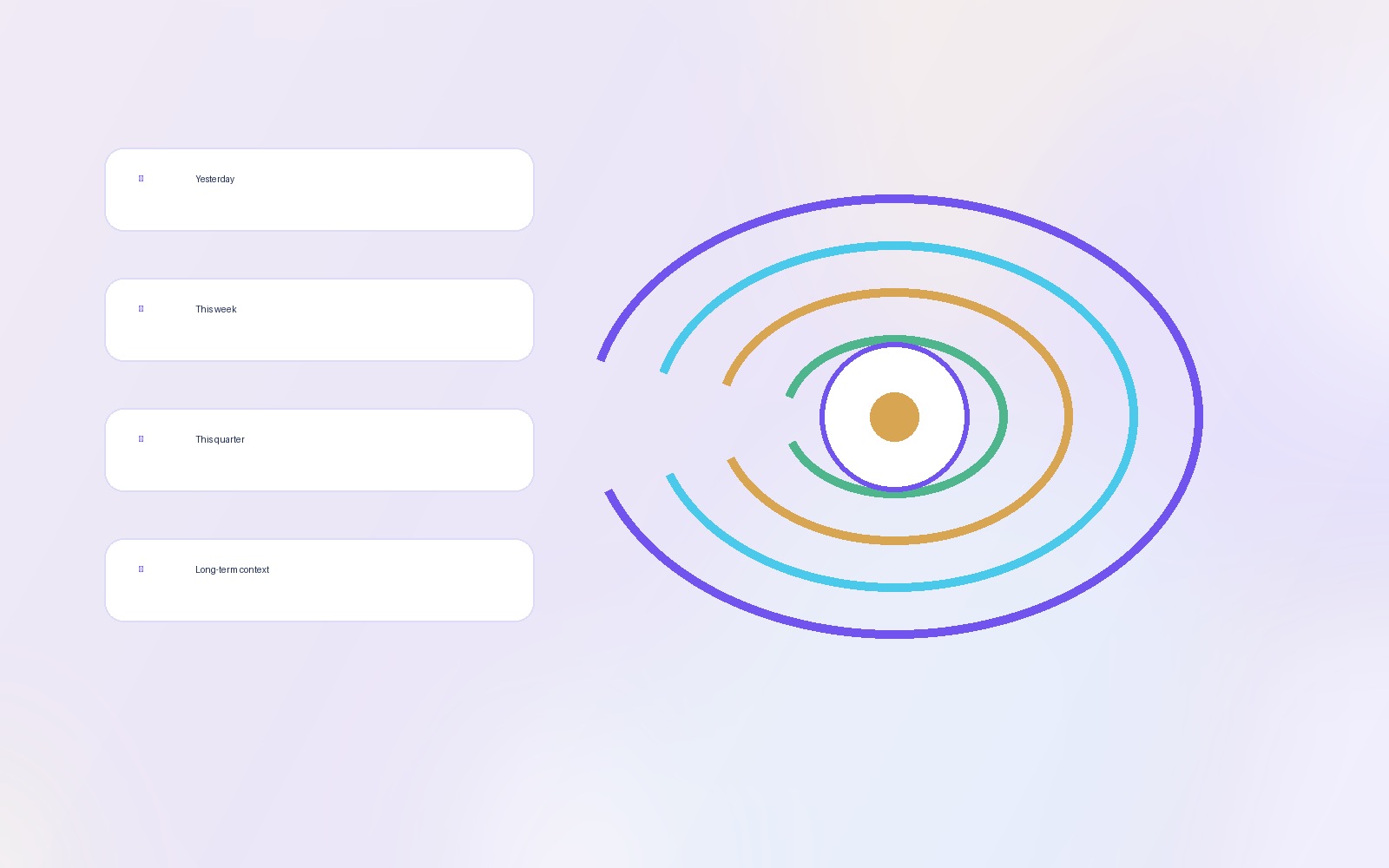
Daily, weekly, and monthly learning
Daily increments
Capture new events, update short-term context, and mark anomalies.
Weekly reflection
Summarize performance, repeat issues, and ranked opportunities.
Monthly calibration
Review goals, strategy, cost, and permission boundaries.
Do not mistake volatility for improvement
The system distinguishes isolated success, low sample size, environmental change, and stable improvement. It preserves sample size, timing, comparison conditions, and human review instead of rewriting strategy after one result.
Start living intelligence with one real workflow.
Start with a measurable, traceable, controllable scenario and retain learning after every cycle.
Turn insight into verifiable evolution.
Book a demo to define the best first scenario.